A boat is never truly still. It rocks, pitches, and rolls with every wave, and any camera bolted to it moves the same way. That movement does not stay outside the frame. It becomes part of the footage.
For an AI system trying to spot a buoy, a swimmer, or another vessel, a shaky picture is a problem before analysis even starts. Detection, tracking, and distance measurement all need a stable image to work from. Removing the boat’s own motion from the video first is called motion compensation. It is one of the least visible but most important jobs a marine AI camera performs.
It is easier to see than to explain. Here is the same clip before and after motion compensation, on both visible and thermal cameras.
Visible-light camera, before and after stabilization
Thermal camera, before and after stabilization
What "camera motion" actually means on a boat
When a camera is fixed to a boat, most of what moves in the video is not the world changing. It is the boat itself moving under the camera. Engineers call this camera ego-motion: the camera’s own motion relative to its surroundings.
A boat’s motion breaks down into six distinct movements, known in marine mechanics as six degrees of freedom:
- Roll: tilting side to side, around the length of the hull
- Pitch: the bow rising and falling
- Yaw: turning left or right
- Heave: rising and dropping straight up and down
- Surge: moving forward and back
- Sway: sliding side to side
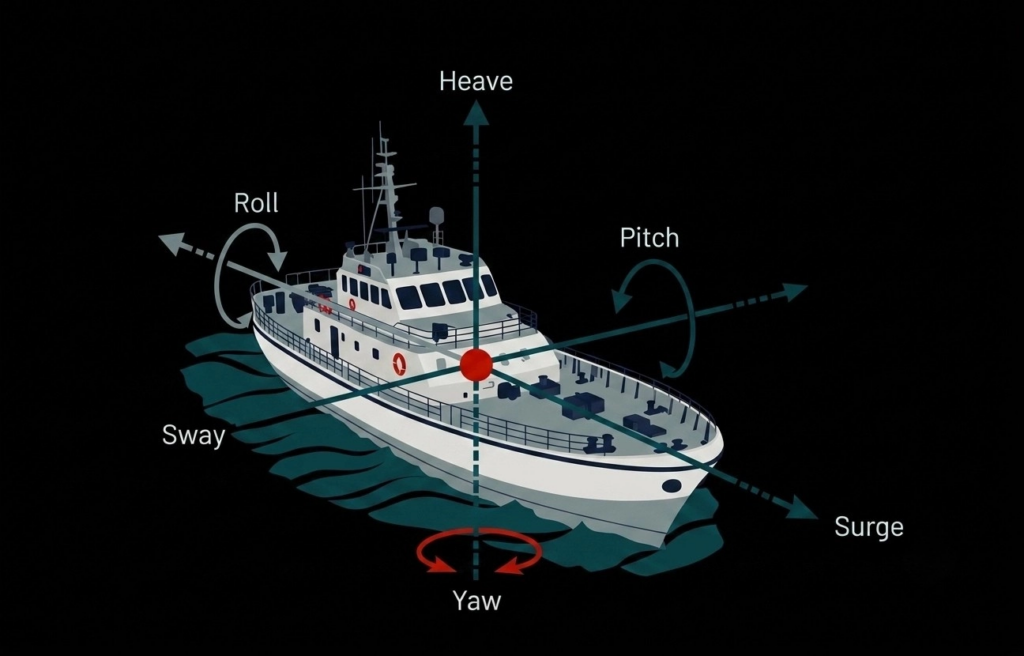
Because the camera is rigidly attached to the boat, it inherits all six of these at once. The core task of motion compensation is to figure out how the camera moved, using inertial sensors, visual data, or both together. The image is then corrected to remove that movement.
Why it matters more than it looks
Picture three video frames of a red buoy, taken moments apart. In the first, the buoy sits on the right. In the second, it is at the edge of the frame. In the third, it is back near the middle. The horizon tilts along with it.
The buoy never moved. It is anchored to the seabed. Every bit of that jumping around was the camera, rocking with the boat.
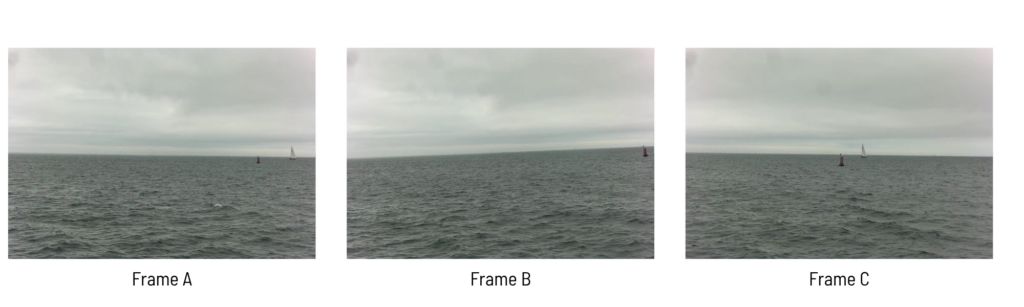
A person watching the video understands this instantly. An AI system does not automatically know whether this apparent movement comes from the object or from the camera, and that is where problems start.
Detection gets harder. A small buoy on a gray sea is already difficult to spot. When it keeps jumping and blurring between frames, the system wastes effort chasing something that never actually moved.
Tracking breaks down. This is the most damaging failure. Tracking means following the same object from one frame to the next. If a stationary buoy appears to leap from one side of the frame to the other, the system can mistake it for a fast-approaching vessel.
Distance and bearing become unreliable. A contact’s position on the water is calculated from where the camera is pointing. A few degrees of error in that estimate means a contact eight hundred meters out can appear to be somewhere it is not. The further away the target, the larger that error becomes.
Once the shake is removed, the buoy stays put on screen even as the boat keeps rolling underneath it. That stillness is what lets an AI system find it, follow it, and place it accurately on the water.
How motion compensation works at sea
Cameras deal with motion on drones, in cars, and in every phone camera. The open sea makes the problem harder, because the motion never stops and the scene gives software almost nothing to hold onto.
On land, software can track fixed reference points such as buildings or road edges to work out how a camera moved. Open water provides very few stable reference points. It shifts, reflects light, and looks similar in every direction.
This is where an inertial measurement unit, or IMU, comes in. Rather than watching the scene, an IMU feels the boat’s own movement directly. Inside it, accelerometers measure linear acceleration along each axis, while gyroscopes measure angular velocity. Together, they allow the system to estimate the platform’s orientation and motion.
Neither sensor is reliable alone. Accelerometers cannot easily tell true motion from the constant pull of gravity, and gyroscopes drift slightly over time as small errors accumulate. Combining the two, a technique called sensor fusion, produces one stable, continuously corrected estimate of how the platform is oriented. The IMU samples hundreds of times per second, far faster than video frame rate, so it captures fast motions that would otherwise slip between frames.
Thermal cameras raise the difficulty further. A thermal image carries far less visual texture than a normal color image, leaving software even fewer features to latch onto. That makes accurate motion sensing more important, not less.
Two ways to remove the motion
Marine AI systems typically combine two complementary approaches:
- Digital stabilization corrects the image in software, using the measured motion, with no moving parts. It is lightweight and reliable, well suited to compact, lower-cost units.
- Mechanical stabilization adds a motorized mount that physically counter-rotates against the boat’s movement, holding the camera level before a single frame is even captured.
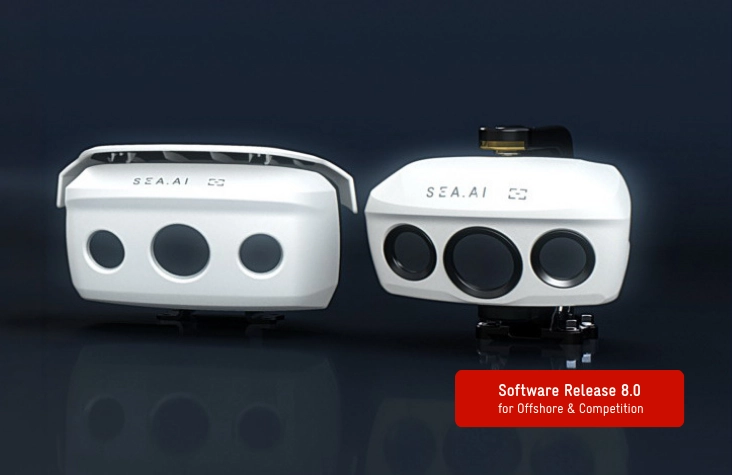
SEA.AI’s Sentry uses both. Its stabilized cameras and onboard processing keep the field of view steady. A detected object stays close to the center of the frame, even as the deck moves beneath it.
Removing motion at the mount and in the image is what turns a shaky detection into a reliable one. A reliable detection, in turn, is what makes tracking and collision prevention possible.
Where it fits in the bigger picture
Motion compensation sits underneath everything an operator actually sees: detection, multi-object tracking, and the contact list on a display. It is invisible when it works. But without it, a wave lifting the stern and a vessel approaching from the bow would look identical to a detection system.
With motion compensation in place, the system reflects what is happening on the water, not what is happening to the boat. That distinction gives the crew information they can act on. Motion compensation is one layer of SEA.AI’s technology, working alongside detection and tracking to turn stabilized imagery into reliable situational awareness.
Frequently asked questions
What is motion compensation?
Motion compensation is the process of measuring a camera platform’s own movement (its roll, pitch, and other motion) and removing that movement from the video, so the footage reflects what is actually happening on the water rather than the motion of the boat itself.
Why does motion compensation matter for tracking and collision prevention?
A tracking system follows each contact from frame to frame, assuming that movement on screen reflects real movement on the water. When the camera itself is pitching and rolling, that assumption breaks down.
A stationary buoy can appear to lunge across the frame, and get mistaken for a fast-moving vessel. Removing the camera’s own motion restores that assumption, so tracks stay continuous and bearings stay accurate.
How does SEA.AI Sentry stay stable at sea?
Sentry combines a compact inertial sensor, which measures roll, pitch, and yaw in real time, with both mechanical and digital stabilization.
The camera is physically held level, and the video is corrected frame by frame, so a detected object stays near the center of the frame and remains correctly tracked as the vessel moves.