The sea does not come with a label.
SEA.AI has been building machine vision for maritime environments since 2018. Our system detects objects at the surface, vessels, debris, people in the water, and alerts crews in real time.
The technology is proven. But classification is only as good as the data behind it. And when it comes to marine mammals, that data has always been the bottleneck.
The reason is simple. You can recreate almost any scenario at sea if you are willing to commit to it. We train man overboard detection with real people, members of our own team who enter the water deliberately, in real conditions, so the system learns what a human in the sea actually looks like across every combination of swell, light, and distance. We deploy and retrieve containers, stage floating debris, photographing it from every angle, in every sea state, at every time of day.
You cannot do that with a whale.
Marine mammals surface on their own terms. They appear briefly, unpredictably, in conditions that cannot be arranged in advance. A fin breaking the surface at dusk. A blow caught on thermal in a two-metre swell. A sperm whale logging at the edge of a shipping lane. These are not moments you can manufacture. They are moments you have to be there for, with the right equipment, in the right place, at the right time.
That is precisely what our partnership with WeWhale makes possible.
The field lab that only nature can provide
WeWhale is an association founded in 2021 with the mission of protecting cetaceans and promoting responsible coexistence between the nautical community and marine wildlife.
Their operations take them into some of the most cetacean-rich waters in Europe, daily monitoring trips, field observation, and active presence in critical habitats including the Strait of Gibraltar, the Canary Islands, and the western Mediterranean.
The Iberian orca is one of the most critically endangered cetacean populations on earth. Fewer than 30 individuals remain. Their habitat overlaps directly with some of the busiest maritime corridors in Europe.
Interactions with vessels, accidental, avoidable, sometimes fatal, are a daily reality.
WeWhale’s current focus is the Save the Iberian Orca campaign, built around daily monitoring from Barbate and continuous surveillance of the orca’s habitat in the Strait of Gibraltar.
Their work is already changing the narrative around these animals, replacing fear with knowledge, replacing avoidance with responsible coexistence.
What real data builds
Cetaceans are not incidental to the health of the ocean. They are central to it. Whales regulate nutrient cycles, support fish populations, and play a role in carbon sequestration that science is only beginning to fully understand.
Losing them is not a localised tragedy. It is a systemic one. And the Iberian orca, with fewer than 30 individuals remaining, is already at the point where every single encounter with a vessel carries weight.
SEA.AI has always refused the shortcut. We were at sea before machine vision was an industry conversation. We built our detection capabilities on real maritime data, in real conditions, because we understood from the beginning that the sea does not reward approximation.
Building the dataset the industry needs
The collaboration is active. WeWhale’s teams are in the field daily, operating across multiple locations along the Iberian coast and the Canary Islands.
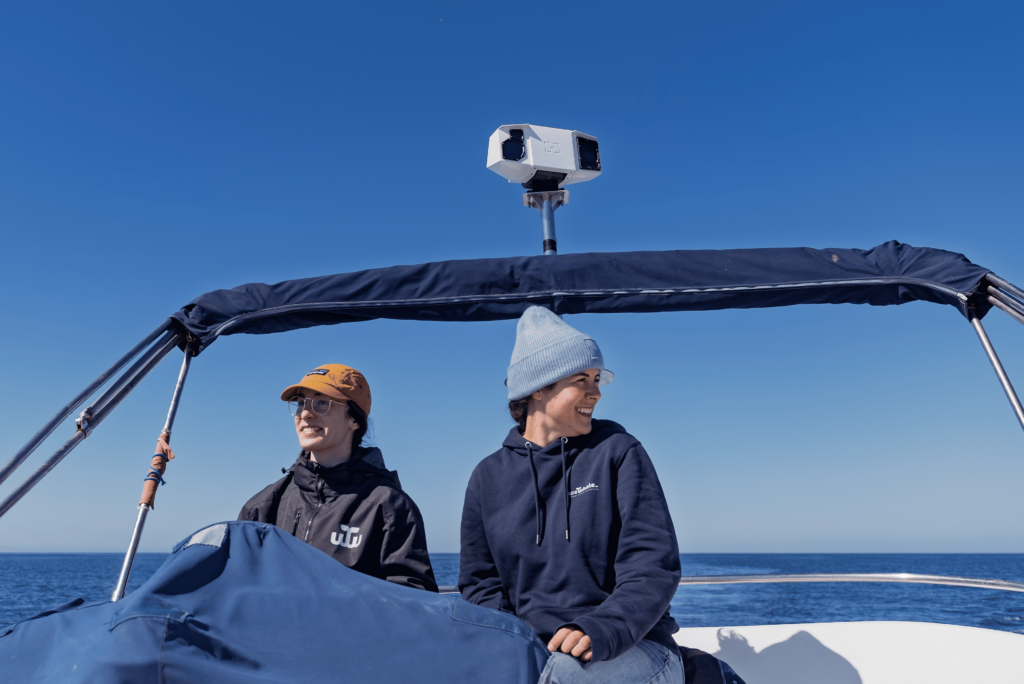
SEA.AI’s sensors are on board, collecting the imagery, thermal data, and real-world detection scenarios that will feed directly into our classification training.
Every sighting adds to a dataset that did not exist before. Every encounter with an Iberian orca, a fin whale, a bottlenose dolphin, documented, labelled, integrated, brings SEA.AI’s marine mammal classification one step closer to the reliability that the industry will eventually require as standard.
The ocean does not offer rehearsals. Neither does the AI that learns from it. What WeWhale and SEA.AI are building together is something that cannot be replicated in a lab, generated by an algorithm, or assembled from second-hand sources.
It is a living dataset, gathered at the edge of one of the most urgent conservation challenges in European waters. NOW YOU SEE.